
I first encountered Robert Henri in an American art history course taught by Gordon Goetemann, who introduced him as the founder of the Ashcan School, an early twentieth-century collective intent on portraying the grit and vitality of modern American life. I wasn’t especially captivated by Henri’s paintings—my own artistic inspirations came later, in the works of Motherwell, Guston, Frankenthaler, Diebenkorn, and others—but I quickly recognized his outsized role in shaping American art. Henri, the course itself, and Goetemann—an intense professor who blended Dionysian passion with Apollonian intellect and wielded a probing, Socratic style of teaching—left a deep mark on me.

Snow in New York, 1902
Robert Henri
Oil on canvas
32″ x 25 13/16″
National Gallery of Art
A year later, I stumbled upon Henri’s voice in a different way. On a campus bookshelf marked “Free,” I unearthed a worn paperback copy of The Art Spirit, his collected writings. The book seemed almost enchanted, summoning Henri’s ghost to speak directly across the decades. He quickly became a mentor in print, urging me to explore deeply, think critically, and live passionately.
Henri spoke, and I listened:
“When the artist is alive in any person, whatever his (her) kind of work may be, he (she) becomes an inventive, searching, daring, self-expressive creature. He (she) becomes interesting to other people. He (she) disturbs, upsets, enlightens, and opens ways for better understanding. Where those who are not artists are trying to close the book, he (she) opens it and shows there are still more pages possible.”
There was the challenge.

Inspired, I once led Henri’s ghost on a tour of my college through a column in the student newspaper—posing questions and letting his words answer, his art spirit observing campus life alongside me. From Henri, I learned to love learning itself: students, teachers, and the spaces that gathered them.
Goetemann and Henri together set me on the path to education as vocation. Henri had shown me that students are the lifeblood of any school, and I came to see my work in admission and marketing as a form of community-building. My task wasn’t simply to persuade or inform but, as Henri would insist, to connect and inspire. Each student enrolled was not merely a customer, but an integral part of the product itself—shaping the experience for all.
This led me to a new set of questions: How do we capture attention? How do we tell our story so it resonates and lingers? My guides here became Chip and Dan Heath, authors of Made to Stick and The Power of Moments. Their research distilled what Henri and Goetemann embodied instinctively: keep messages simple and unexpected, ground them in story and emotion, and focus not on smoothing life’s bumps but on creating peak moments—elevations, insights, connections—that endure.
Henri would have nodded: “What we need is more sense of the wonder of life and less of this business of making a picture.”
For Henri, art was never confined to the studio. For Goetemann, art history was never limited to slides and lectures. In our final project, we students embodied American artists—Warhol, O’Keeffe, Judd—debating which ten works best defined American art. Still in costume, we marched to the local sub shop to continue the argument. Gordon picked up the tab. It was unforgettable, and it stuck.
Through his teaching methods, it turns out, Gordon was Robert Henri—as passionate about teaching as he was about painting. Decades before the Heath brothers published their books, he was already applying the same principles—messages that resonated, moments that mattered. I loved that course so much, I sat through it again.

Gordon Goetemann in his Gloucester, Mass. home.
Read Gordon’s obituary.
Years later, not long before his death, my wife, daughter, and I visited Gordon and his wife in their Gloucester, Massachusetts home. Over what his wife called a “Gordy-sized portion” of pasta, we shared memories, admired his magnum opus (a series of paintings inspired by Mahler’s Second Symphony), and reveled once more in the conversations that first set me on my path.
The art spirit was alive then, and it remains alive now—shaping how I see the world, how I create, and how I approach my vocation.
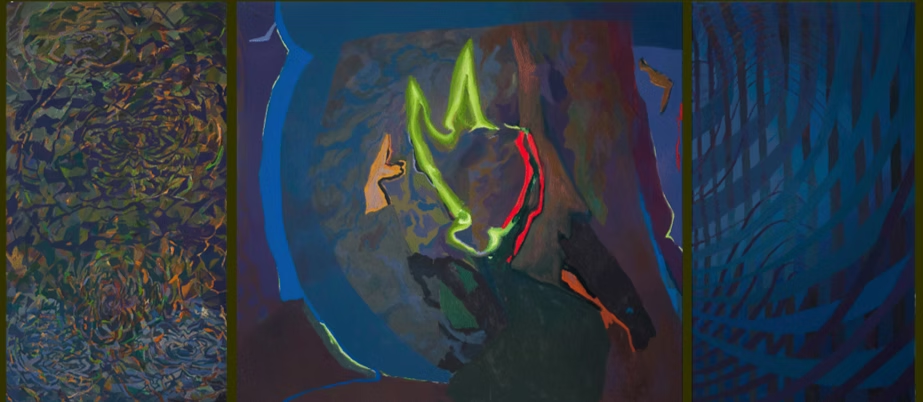
Read about and view the suite of paintings.