

Many colleges struggling with enrollment are likely facing not one but three core challenges, ranging in severity from bad to worse to worst.
Before I continue, an important aside: I finally got an ant tattoo.
Why?
Because no one listens to me.
Ever seen Bee Movie? That animated film with Jerry Seinfeld as Barry B. Benson? There’s a moment when Barry, exasperated that no one’s paying attention to his story, blurts out, “I can say anything I want right now. I’m gonna get an ant tattoo!”
Absurd? Sure. But also relatable. Especially in higher ed marketing, where being unheard sometimes feels like the default. So whether you’re listening now or not—I’ll proceed anyway.
(For the record, the ant tattoo wasn’t a midlife crisis. It was a long-running family joke. My wife and daughter got one too. Think less existential despair, more shared eye-roll—and a tiny reminder that sometimes you have to laugh before you buzz on.)
The First Problem (It’s Bad)
The initial and most basic challenge is that many colleges have spent substantial time, money, and effort focusing on solutions that didn’t address the true problems. This is reminiscent of the bees in Bee Movie endlessly chasing a flower-shaped air freshener on a speeding car — an effort that looks like the pursuit of nectar but yields no honey.
- The colleges’ problem wasn’t their data or analysis—though it’s ironic that institutions teaching research methods and critical thinking too often fail to implement them in their marketing. (Oh, the logical fallacies I endured.)
- It wasn’t their student search strategy, name buys, or predictive models.
- It wasn’t their search engine marketing, digital ads, billboards, or pre-roll YouTube spots.
- It wasn’t their website’s design, navigation, SEO, or “Apply Now” button placement.
- It wasn’t their customer relationship management system or their content management system.
- It wasn’t their email flows, customized publications, personalized videos, or telemarketing and text messaging campaigns.
- It wasn’t their fonts, colors, logo, tagline, or brand style guide.
- It wasn’t their social media platforms or the interns posting “fun facts” every Friday.
- It wasn’t their admissions representatives or enthusiastic student tour guides.
- It wasn’t their open houses, campus visit programs, or VIP tours.
- It wasn’t the consultants hired to audit or fix recruitment practices.
- It wasn’t their application—no matter how short, simple, or mobile-friendly.
- And no, it wasn’t their use of AI—though it’s a helpful co-author of this piece, and a multitasking marvel that can also segment audiences, personalize communications, analyze enrollment data, and even suggest which shade of red makes prospective students click “Apply.” (ChatGPT wrote that.)
These are tools rather than solutions–just busy bees buzzing around chasing every little tactic while missing the big, sweet flower garden that actually fuels the hive.
While tactics matter, true progress demands inspiration and clarity of vision.
The Second Problem (It’s Worse)
While colleges were committing their limited resources to the tactical activities above, they’ve missed the real problem: Their product (including place and people), packaging, promotion, and price are not nearly attractive enough, and that is wreaking havoc on their efforts to stand out in an overcrowded higher education market.
Product
Colleges are special because the college experience is special. But the hard truth is this: most colleges aren’t exceptionally special. Not in a way that stands out. They offer what nearly every other college offers—happy students, supportive faculty, and graduates who go on to do well. They offer academics, athletics, internships, study abroad, research opportunities, residence halls, a campus coffee shop, time-honored traditions, and so on.
Distinct = rare and powerfully appealing.
What colleges lack is a truly distinctive product—programs, experiences, or characteristics that are both rare and powerfully appealing. Without the prestige of highly ranked colleges or the drawing power of flagship universities, colleges are just another school in a crowded field.
Packaging
The way colleges package their offerings is just as uninspired as the offerings themselves. If it’s hard to differentiate on product alone, then the bold move is to repackage it in a way that catches the eye of an otherwise indifferent audience.
Take this example: years ago, I was conversing with an academic dean at a college that had decided to phase out its traditional January Term (J-Term) and instead expand summer opportunities. However, with no real leadership in place to establish a clear positioning, the branding defaulted to “May Term”—a generic label borrowed from other institutions, although most of the programs didn’t start or end in May.
I proposed that the college package these engaged summer learning experiences as the [College Name] Summer Experience—a unified platform that could include internships, research opportunities, and global study programs. It had the potential to feel fresh, intentional, and expansive.
“I was told with an air of academic disdain,
“After all, we are an educational institution.”
Instead, the dean opted for Summer Term—a term even more generic than May Term. When I questioned it, I was told, with an air of academic disdain, “After all, we are an educational institution.” That’s the problem. Summer Term sounds like required or remedial classes in overheated classrooms—nothing aspirational, nothing distinctive, nothing memorable. And certainly nothing that would excite a prospective student or set the college apart.
Promotion
College marketing campaigns are gawd-awful boring. Their brand personality is milquetoast. If your story isn’t truly distinctive, then how you tell it had better be. You need metaphor, humor, surprise, imagination—anything that breaks through the noise and makes the indifferent care, even for a moment.
However, the people making the marketing decisions have no real understanding of the challenges at the top of the enrollment funnel. They haven’t sat across from prospective students and families, walked the halls of high schools, built relationships with counselors, or stood for hours at college fairs watching disinterested students drift past on their way to the big-name booths—flagship universities and highly ranked, well-endowed colleges.
Yet somehow, those campus leaders are brimming with confidence about how things should be done. “If only admission did a better job of telling our story,” they say.
I once heard a college administrator recommend that marketing report to advancement because, as it was argued, “It’s the only office that works with an external audience.” The irony, of course, is that advancement deals almost exclusively with loyal alumni—the most internal of external audiences. Admissions, meanwhile, is out there every day trying to capture the attention of people who don’t know the college, don’t care about the college, and are provided with little inspiration to move from indifferent to intrigued.
Price
Without the other three differentiators, colleges are left competing on price—and that’s a losing game. No new discount matrix, tuition reset, or rebranded scholarship will fix the problem. No one cares what a college costs if they’re not interested in it to begin with. And even if they are interested, colleges struggle to lower the price enough to convert that interest into real commitment.
The Third Problem (It’s the Worst )
For many, it is too late.
Colleges saw the demographic cliff coming. Everyone did. And yet, for many colleges, enrollment struggles began before the downturn. Still, confidence—and an unshakable belief in the high quality of their product—led them to dismiss the urgency of the warnings.
For many colleges (based on higher education job boards), the solution was hiring a new vice president of enrollment, and then a new chief marketing officer. Then they replaced them. And then they replaced those replacements. These new thought leaders wrangled a bigger marketing budget, swapped vendors, tested new tactics, added billboards, removed billboards, and (once again) redesigned the website.
None of it worked. They’ve now settled into the “new normal enrollment,” which might soon be replaced by the “even newer normal enrollment.”
Why?
Because those are not the real problem.
The real problem and much bigger problem—the one avoided all along—is that the college’s product, packaging, promotion, and price simply aren’t compelling enough to attract students.
And no amount of tactical shuffling can cover for that.
So What Now?
If you’ve made it this far, either you’re listening—or you’ve got an ant tattoo, too. So here’s what to do about it:
1. Rethink Your Product
Stop assuming your core offering is good enough. Conduct a brutally honest audit of your academic programs, student experiences, outcomes, and differentiators. What do you offer that’s:
- Rare?
- High-value?
- Undeniably attractive?
If the answer is “not much,” invest in creating or elevating student experiences that are. Traditionally mission-driven organizations must make market-driven decisions. That might mean launching a high-demand academic pathway, embedding guaranteed internships (see Northeastern University, where my daughter is a senior, for something extraordinary), or building unique experiential learning that aligns with what students and employers care about. Require departments and programs to add rare and attractive features and offerings. And, remember that academics is only a part of the reason students are attracted to the college experience.
Recommended reading:
“America will Sacrifice Anything for the College Experience.”
Ian Bogost, The Atlantic
2. Repackage with Intention
If your product can’t be radically different, then the packaging must be. Design matters. So does naming, framing, and storytelling. Your goal is to make even familiar things feel new, intentional, and impossible to ignore.
Ask these questions:
- Does this offering look and sound exciting?
- Would a 17-year-old care?
- Would a parent get it without explanation?
- If not, start over. Use the language of possibility, not process.
3. Tell a Story Worth Hearing
Your promotion isn’t failing because you don’t have good people—it’s failing because you’re playing it safe. Safe is invisible. You think promotion is about persuading and informing, when it’s initially and most importantly about inspiring and engaging.
Effective marketing in higher ed requires:
- Bold storytelling
- Real emotion
- Humor (yes, humor!) and metaphor
- Visual punch (Ogilvy on Advertising is still relevant)
- And enough surprise to earn a second look (that’s a big and growing challenge)
- Invest in people who know how to reach an indifferent audience—marketers who think like creatives, not committee chairs. And empower them to take smart risks.

For one viewbook, I painted a classic one-piece desk bright red—the college’s color—and sent it across campus, the country, and the world to showcase student learning: from a classroom and an orchestra concert to a zoo internship (yes, with a student feeding an elephant from the chair) and study abroad in London. The bold, memorable campaign was later replaced by a viewbook as forgettable as the experience it implied.

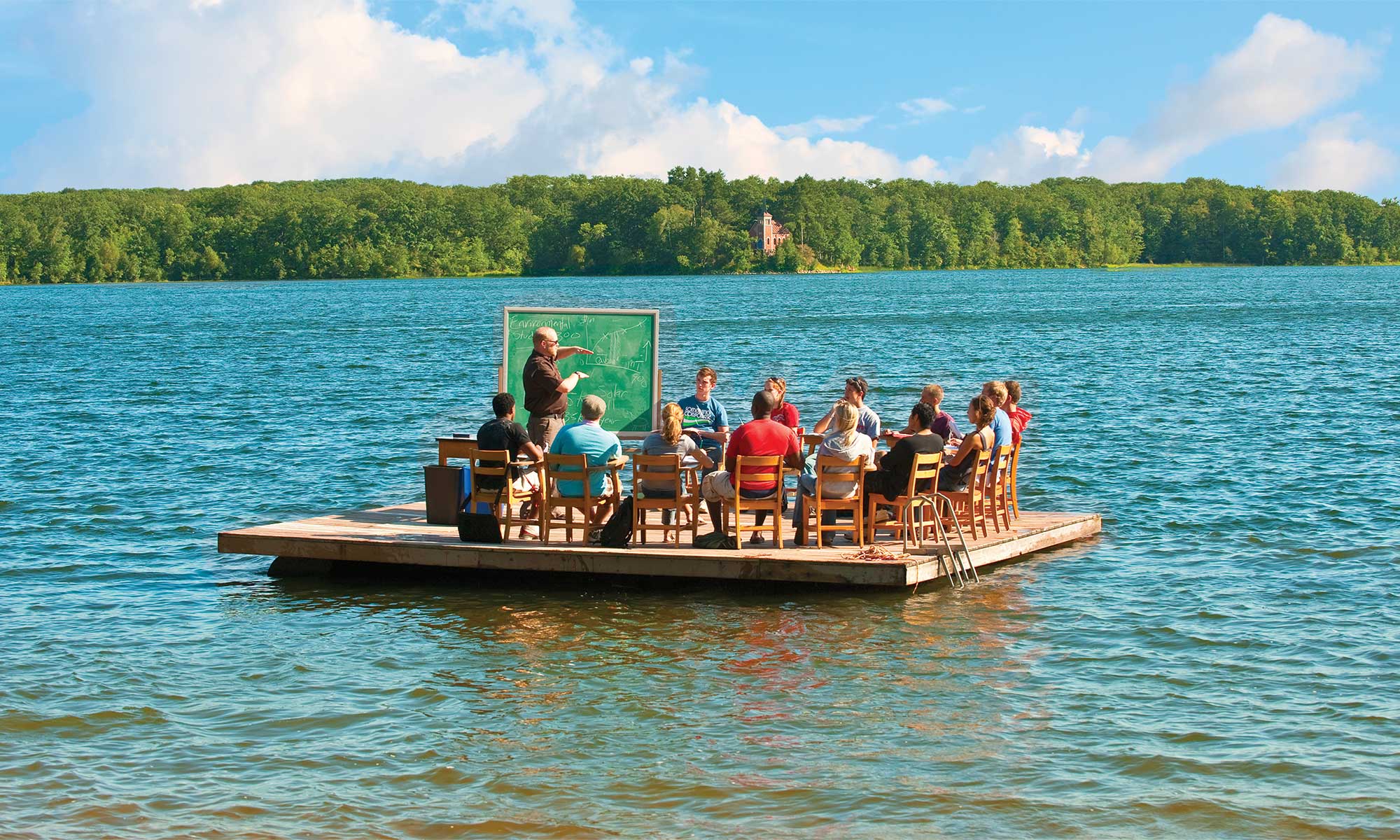
In another campaign, I turned the large floating raft at the college’s beach into a stage to showcase the college’s offerings. The four sides became the four years of the college experience and the raft became a platform featuring vignettes from campus life: a classroom, a choir concert, a basketball game, study abroad in China, a dorm room, and many more. The audience loved it—but the college, despite the buzz, retreated to the safety of the mundane.
I built an expansive and unmatched virtual tour featuring engaging 360-degree videos. The college has since migrated to an expensive, uninspiring, off-the-shelf product used by scores of other colleges. Same story. Same platform. Different college.
I sent our team around the region to connect with prospective students and families while delivering care packages featuring items unique to the college. We took photos of our deliveries and posted them to social media. Our external audience loved it. Our internal leadership didn’t seem to share their enthusiasm.
You need to create a buzz. Buzz marketing matters because it grabs attention in a way traditional strategies often can’t. Like Barry in Bee Movie, who had to do something unexpected to be noticed, colleges must break out of their predictable patterns. In a crowded market, safe and standard won’t generate interest—or applications. Buzz marketing creates curiosity, conversation, and shareability. It turns a college from just another booth at the fair into something people are compelled to talk about.
Furthermore, you need your hive—your community—spreading the word like pollen. Dig deeper into your incoming class to uncover what truly sparked their interest. How did they first hear about you? What made them care enough to learn more? Without the built-in advantage of brand recognition (flagship universities) or brand reputation (highly ranked colleges), genuine interest likely began with a personal connection. While your CRM may point to “first source” or “first inquiry,” don’t over-credit your search campaigns or email blasts for moving students from indifferent to intrigued and interested. The spark almost always comes from something more human—word-of-mouth, a trusted recommendation, or a meaningful experience.
4. Compete on Price and Value—But Do It Strategically
Affordability matters, especially for cost-conscious students and families navigating a crowded, overpriced market. If your price point is a strength, absolutely make it known. But don’t let discounting be your only move. Price may open the door, but value closes the deal. Show prospective students what they get for that price: meaningful academic and personal growth, strong outcomes, access to opportunity, and a community they want to join. Yes, cost comparisons have a place—but only after you’ve made someone care enough to compare. So lead with a compelling reason to look closer, then reinforce your case with affordability that feels like a smart investment.
Higher education is one of the rare industries where customers are also an important part of the product. The students you attract and enroll don’t just consume your brand—they embody it. Exceptional students become natural brand ambassadors, fueling stronger recruitment and greater success. Through them, you build strong brand islands (schools and communities). That’s why investing in the right students matters. It’s an investment in your product and your brand.

See my Think Again publication for an example of a brochure that communicates affordability and value. A major higher-education vendor circulated it internally as a model of outstanding promotional work.
5. Build a Culture of Market Awareness
Your leadership team must stay connected to what’s actually happening at the top of the funnel.
That means:
- Reading inquiry emails.
- Attending high school visits and college fairs.
- Listening to focus groups with students who didn’t enroll.
- Talking to admissions counselors about what they’re hearing.
- Getting outside your echo chamber.
- Come to the conversation with modesty and recognize the expertise of your front-line employees.
6. Be Urgent, But Strategic
No, you can’t fix this overnight. But you also can’t afford another year of surface-level changes and rearranged org charts.
Start with these questions:
- What college would we want to attend if we were 17?
- What’s one bold move we could make this year to shift perception?
- What would it look like if we marketed with conviction instead of consensus?
- Then move quickly. The longer you wait, the fewer options you’ll have.
Final Thoughts
The enrollment cliff isn’t just a demographic dip—it’s an extinction event for institutions that lack brand recognition, brand reputation, and large endowments, and refuse to adapt. But for those willing to change, differentiate, and market with courage, there could still be hope.
Begin by watching the Bee Movie. Yes, really. Barry B. Benson offers valuable lessons about resilience and creative problem-solving in the face of seemingly impossible odds. He challenged assumptions, refused to accept “that’s just how things are,” questioned authority, broke rules when necessary, and found innovative solutions by thinking outside conventional boundaries.
When everyone told Barry that bees couldn’t talk to humans, he talked anyway. When they said bees couldn’t sue humans, he sued anyway. When they said the natural order couldn’t be changed, he changed it anyway.
Most importantly, Barry understood that extinction isn’t inevitable—it’s a choice. The choice to keep doing what isn’t working. The choice to play it safe when safety itself has become dangerous. The choice to remain comfortable while the world changes around you.
Your college’s survival depends on making different choices. The question is: will you make them in time?